Powering Chicago Homepage Featured
Powering Chicago Shines a Light on the Birth of Local Unionized Labor at the A. Philip Randolph Museum
February 24, 2026
The birth of unionized labor in the Chicago area didn’t happen by accident. It happened because of the hard work and perseverance of men and women who knew that they deserved better than what their employers were providing them. One of the first examples of local union labor is the story of the Pullman porters.
Starting in the late 1860s, the Pullman porters were formerly-enslaved African American men hired to work on the railroads as porters on sleeping cars, designed and manufactured by American engineer and industrialist George Pullman. The porters were tasked with carrying baggage, shining shoes, maintaining the sleeping berths, and otherwise serving passengers. The porters found themselves working extremely long hours, with little pay, often only sleeping four hours a day while sitting up in the smoking car. They even performed the duties of a train conductor, without conductor’s pay.
Seeking fair treatment and working conditions, The Brotherhood of Sleeping Car Porters (BSCP) formed on August, 25, 1925, under the leadership of A. Philip Randolph, an American labor unionist and civil rights activist. The BSCP was America’s first Black labor union to receive a charter under the American Federation of Labor. Nearly 12 years after the union’s formation, the Pullman Company finally acquiesced to the union’s demands, establishing the standard of the middle class in the Black community. The protections of the BSCP allowed members the financial freedom to be property owners, business owners, and even to pay for their children’s college education.
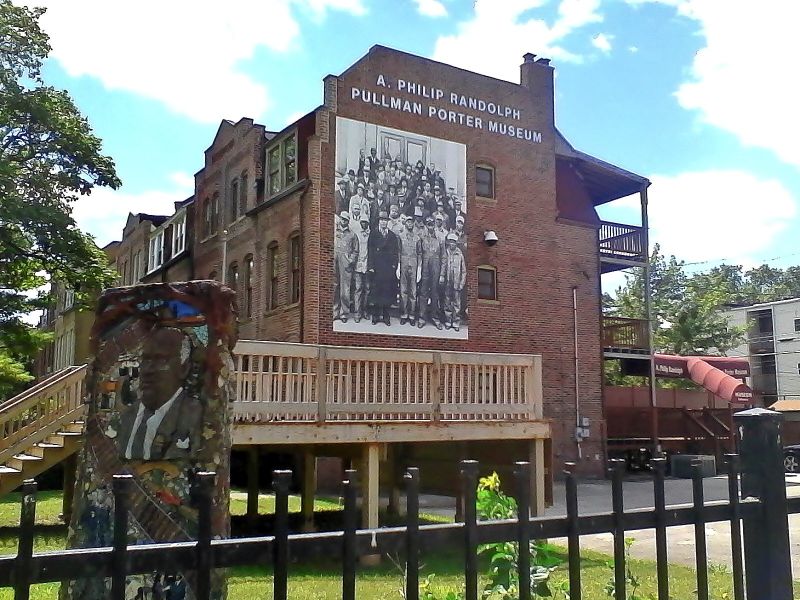
The story of the Pullman porters and The Brotherhood of Sleeping Car Porters was highlighted on a recent episode of ABC 7’s Built to Last, an Emmy-nominated program that features trade union members and contractors from the Chicagoland area. This segment also shows the work of union electricians and contractors to illuminate a mural on the side of the A. Philip Randolph Museum, the nation’s first African American labor history museum, located in the Pullman National Monument on the city’s South side.
Together, the Electrical Workers Minority Caucus and IBEW Local 134 identified the opportunity for Powering Chicago to help with, literally and figuratively, shining a light on the birth of unionized labor. Powering Chicago paid for all materials and lighting, connecting IBEW Local 134 members and contractors to donate their time and skill to ensure one of the most important figures in organized labor history, A. Philip Randolph, is highlighted in the Pullman area.
A story often untold in school history courses, the BSCP offered proof of concept for what organized labor looked like and a foundation for the IBEW 134 and other local building trades. The inspiring story of the BSCP came to life for the IBEW 134 apprentices who recently visited this museum, walking away with a better appreciation for the many sacrifices made to form a union and with pride in continuing the organized labor movement in Chicago.