Ours To Protect Homepage Featured|Powering Chicago Homepage Featured
IBEW Local 134 Is Training The Next Generation Of Solar Workers
February 24, 2026
Imagine a scenario where thousands of high-paying jobs are available to workers — without requiring eight to ten years of education or tens of thousands of dollars in student debt. Now imagine those jobs also help combat climate change, grow the energy sector and provide opportunities to historically marginalized communities.
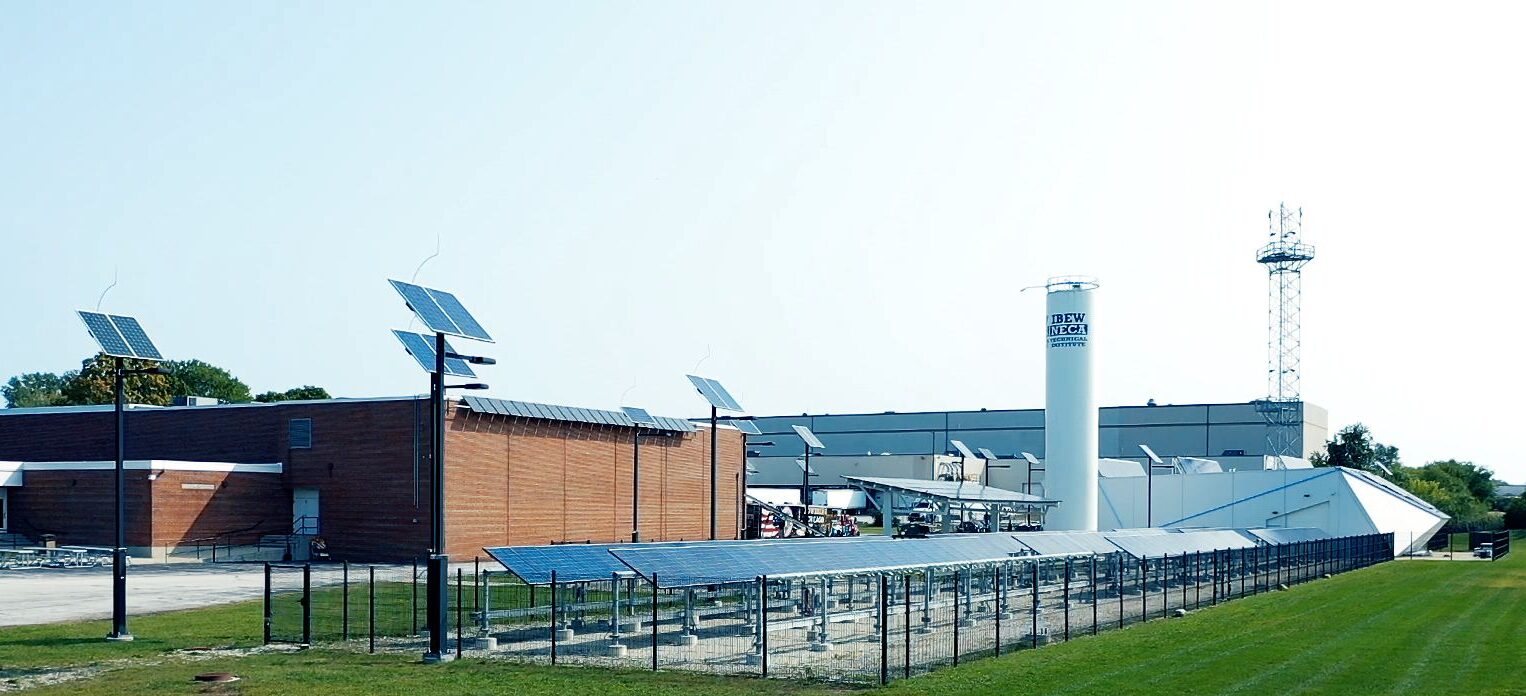
That’s exactly what’s happening at the IBEW/NECA Technical Institute (IN-Tech), the state-of-the-art training center where dozens of Chicago-area high school students are being trained to work in the solar sector. The program, which lasts two weeks and ends with on-the-job opportunities with contractors, puts students on track to earn an upper-middle class income with benefits, retirement savings and more.
Teaching a new generation the benefits of solar
Think of the IBEW Local 134 solar academy program as a crash-course in both renewable energy systems and basic electrical work: students learn how to wire circuits, install equipment and work hands-on with industrial-scale solar panels from the same instructors who teach IBEW Local 134 electricians.
Completing the program renders students pre-apprenticeship electricians, enabling them to work in a contract solar job while also opening the door to allow for further education. Should they choose to continue with this path, students can choose to apply for the electrical apprenticeship program at IN-Tech.
Making a difference in marginalized communities
Not all high school students are granted the same opportunities. Just ask Santino Ruvalcaba, a student who completed the two-week solar program in hopes of providing for his family. In a conversation with Youth Today reporter Michael Gerstein, Ruvalcaba spoke about how a solar apprenticeship would directly contribute to a better quality of life for those around him.
“[My mom] always wanted to be a teacher, but she couldn’t because of the money for college,” Ruvalcaba said. “My dad, he’s a manager for a warehouse, so most of his paycheck money goes to rent and stuff. So it’s not that much, but it still keeps us afloat. Whatever benefits me benefits them — that’s how I see it.”
Ruvalcaba’s goals are shared by many of the students who complete the solar academy. Most are excited by the prospect of a program that leads directly to a job and promises engaging, rewarding work.
Boosting the solar workforce in Chicago and beyond
Programs like the IBEW Local 134 solar academy are especially exciting for local electrical contractors, who will need additional labor to meet a growing demand for renewable energy sources. That’s especially true in the wake of the Inflation Reduction Act, the government’s largest climate bill to ever pass — a bill that includes major incentives for greater renewable energy infrastructure.
On a state level, Illinois lawmakers have promised to generate 40% of all local electricity using renewable sources by 2030. It’s an ambitious goal, one made more so by an additional provision that requires 30% of all renewable energy workers to come from marginalized backgrounds, such as families impacted by environmental racism or educational barriers.
While some industry members have discussed the difficulty of meeting these benchmarks — with many citing an inability to find enough qualified workers from disadvantaged backgrounds — instructors at IBEW Local 134 say this is exactly why educational programs such as the solar academy are crucial.
Mijin Cha, an urban environmental policy professor who praised the program, put it bluntly: “[To those complaining], why don’t you know how to diversify your workforce? I don’t see any way except to just do it. Now’s the time to start creating these pipelines.”
With plans to continue the program, increase the number of participating schools and provide even more contractor jobs to students going forward, the IN-Tech solar academy shows no signs of slowing down. That’s good news for future students, IBEW Local 134 instructors and Chicagoans alike.